In 2005, a Nevada liquor wholesaler named Larry Ruvo and casino developer Harvey Whittemore found themselves in front of the 9th Circuit Court of Appeals arguing about a dock. Both men owned property near Glenbrook's shoreline and had used the community pier for years with the Glenbrook Homeowners Association's blessing. When they applied to build a private pier of their own, a federal panel had to settle a question that sounds almost absurd for waterfront this valuable: did they actually have a legal right to the pier they had been using all along? The court's answer was no. Ruvo was not a member of the GHOA, and the ruling made clear that using the community pier for years did not create a deeded right to it.
That case is two decades old, but the principle it settled still governs every Glenbrook purchase today. The lake is not what the deed transfers. What the deed transfers is land and a house. Everything that makes Glenbrook worth the price, the pier, the water, the ability to rent it out if plans change, sits on top of the deed as a separate layer of membership and permission. Some of that layer follows the sale automatically. Some of it does not follow at all, and a buyer who assumes otherwise can close escrow and discover the gap only when they try to use the thing they thought they bought.
The Common Elements Are Allocated, Not Owned
Glenbrook's beaches, its pier, and its managed buoy field are Common Elements under the community's recorded CC&Rs, which means the GHOA controls access to them rather than any individual lot owner holding a deeded right. For most buyers this distinction is invisible because most Glenbrook parcels are GHOA members in good standing, and membership brings the expected privileges: beach access, a spot in the buoy queue, use of the pier.
The complication is that not every parcel inside the gates carries that membership. Some historic lakefront properties, including portions of the area long known locally as Shakespeare, are described in title materials as non-affiliated with the GHOA. A non-affiliated parcel can sit two lots from a member parcel and share none of its Common Element rights. Ruvo's property fell into exactly this category, which is why decades of informal, HOA-granted access still lost in federal court once someone challenged it.
For a buyer, this turns a routine question, does this house come with beach and pier access, into a title question rather than a listing-sheet question. The answer lives in the parcel's recorded HOA status and the GHOA's own CC&Rs, not in whatever a seller or a photo caption implies.
The Water Runs on Its Own Membership
Domestic water in Glenbrook comes from the Glenbrook Water Cooperative, a member-owned utility separate from the HOA, serving roughly 288 households. It is not a detail most buyers think to ask about until they are already planning a kitchen remodel or a second bathroom, at which point the cooperative's physics become very relevant.
The system's pressure is governed by elevation. The storage tank sits at approximately 6,510 feet, and every 23 feet of elevation difference between a connection and the tank adds about 10 psi of static head pressure. A property near lake level, roughly 285 feet below the tank, can see static pressure around 123 psi before the pumps even engage, and pump activation adds up to another 20 psi on top of that. The cooperative is explicit that it does not maintain or warrant a member's interior piping against pressure or pressure spikes. That responsibility sits with the homeowner.
None of that is disclosed on a typical listing sheet. It shows up in the cooperative's own bylaws, and it belongs in escrow. A buyer planning any plumbing work, or simply wanting to know their home's baseline pressure before it becomes a leak, should request the cooperative's membership status and recent maintenance history as a specific, named item in due diligence rather than folding it into a generic inspection request.
The Rental Wall Has Two Gates, Not One
If you are looking at Glenbrook with any expectation of short-term rental income, there are two separate obstacles, and clearing one does not clear the other.
The first is Douglas County's own cap. Vacation Home Rentals across the entire Tahoe Township, which includes Glenbrook, Zephyr Cove, and Stateline, are capped at 600 total permits. As of May 11, 2026, the county had issued 556, leaving roughly 44 remaining and available only in neighborhoods still classified as unconstrained. Full neighborhoods offer nothing but a paid waitlist. Even where a permit exists today, it does not survive a sale. Permits belong to the operator, not the property, and are extinguished at closing. A buyer has to apply fresh under whatever rules are in force on the day of that application, which in a full neighborhood can mean applying for something that no longer exists to grant.
The second obstacle is Glenbrook's own governing documents, and it applies regardless of county capacity. The recorded CC&Rs prohibit timesharing arrangements outright, and they require any owner who leases a home to formally delegate their Common Element rights to the tenant, with the Association empowered to enforce community rules against both owner and renter directly. That is a meaningfully tighter structure than a simple county permit requirement. It means an owner cannot treat a lease as a transaction between two private parties and let the HOA relationship sit untouched in the background.
Uppaway Estates, the small gated enclave adjoining Glenbrook's main gates on the former Fleishman family estate, runs an even simpler version of the same policy: no short-term rentals, full stop, under its own separate HOA. If income potential is part of the plan, Uppaway settles the question before you get to the county paperwork at all.
What This Means Before You Write an Offer
The pattern across all three systems, the Common Elements, the water cooperative, and the rental permitting, is the same. Each one is a membership or an allocation that sits next to the deed rather than inside it, and each one can behave differently than the seller's current experience of the property. A seller who has enjoyed pier access for thirty years under a grandfathered arrangement is not proof that the arrangement transfers. A seller's current VHR permit is not proof that a new owner can operate one. A seller's water pressure complaints, or lack of them, are not proof of what a buyer's fixtures will experience at a different elevation on the system.
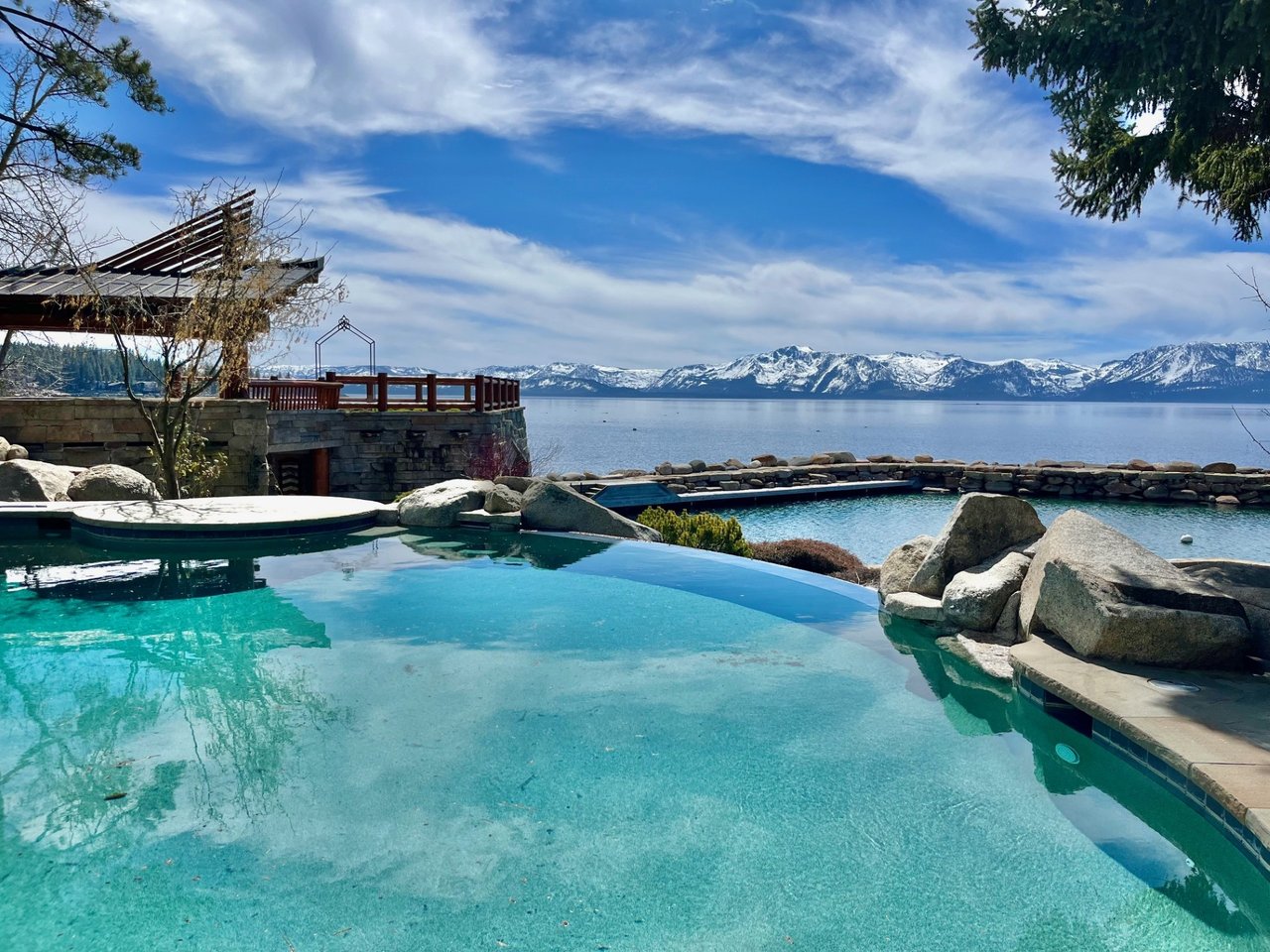
Before an offer goes in on a Glenbrook or Uppaway property, it is worth confirming, in writing, four specific things: the parcel's GHOA affiliation status and what Common Element rights attach to it, the current buoy or pier allocation if any and whether it is transferable, the property's standing with the Glenbrook Water Cooperative along with recent maintenance records, and the current status of any VHR permit including whether the neighborhood is constrained under the county's waitlist system. None of these are exotic requests. They are the specific documents that turn a listing photo of a private dock into an enforceable right to use one.
Glenbrook and Uppaway remain two of the rarest addresses on Lake Tahoe's East Shore, and for buyers thinking in terms of legacy ownership rather than income property, that rarity is the entire point. The properties trade infrequently, the gates stay quiet, and the community's structure protects exactly that kind of long-term privacy. But privacy protected this deliberately is also privacy that keeps its rules layered, and a buyer who understands the layers going in negotiates from a stronger position than one who discovers them during escrow.
If you are evaluating a purchase on Glenbrook's shoreline or in Uppaway and want a clear read on what a specific parcel's membership status actually includes, Tahoe Icon works these transactions from the inside. Schedule a private consultation with Lexi Cerretti before you write the offer.
Quick Answers for Glenbrook and Uppaway Buyers
Does every Glenbrook lakefront home come with deeded pier or buoy rights? No. Access to the pier and buoy field runs through GHOA membership and the Association's own allocation procedures under the CC&Rs. Some historic lakefront parcels are non-affiliated with the GHOA and do not carry the same rights, a distinction that was tested directly in the 2005 pier case.
Can a new owner get a short-term rental permit in Glenbrook? It depends on two separate approvals, not one. Douglas County's Tahoe Township permit program is capped at 600 total permits, with 556 issued as of May 11, 2026, and permits do not transfer at sale under any circumstance. Glenbrook's own CC&Rs add a second layer, prohibiting timesharing and requiring formal delegation of Common Element rights to any tenant.
Is water included with the property, or is it a separate cost? Water comes through the member-owned Glenbrook Water Cooperative, a separate entity from the HOA. Membership, pressure zone, and maintenance history are worth confirming directly with the cooperative during escrow, particularly if renovation or expansion is part of the plan.